A record number of Black candidates are nominees for governor. Here’s what you should know.



The historic field spans party lines, with several candidates seeking to become their states’ first Black governors this November.
Black candidates have dominated in gubernatorial primary races across the country, securing nominations and forging a path to making history this November. In this midterm election, there is a record number of Black gubernatorial nominees, reflecting an opportunity for progress in Black representation in electoral politics, even as that representation faces major setbacks as states eliminate majority-Black districts across the South amid rollbacks of protections under the Voting Rights Act.
What’s more, the record number of Black gubernatorial nominees is reflected across political affiliation, even while both the Democratic and Republican parties face criticisms over their relationship with Black voters.
Currently, only one Black governor is serving in the United States: Maryland Governor Wes Moore, who is running for re-election this November. To date, only three Black Americans have ever been elected governor of a state.
Ofirah Yheskel, Director of External Affairs at the Democratic Governors Association, tells theGrio that the DGA is committed to ensuring that after November, Moore is no longer the only one.
“The stakes are pretty high, and so electing more Black governors in this country will be huge in terms of having more voices who understand personally what’s going on and can take action on that,” Yheskel tells theGrio.
Keisha Lance Bottoms, Democratic gubernatorial nominee in Georgia

Keisha Lance Bottoms is the only Black female gubernatorial nominee on the ballot this November. If elected, she would not only become Georgia’s first Black governor, but the first Black woman elected governor in U.S. history. The former mayor of Atlanta faces a tough gubernatorial contest against Republican nominee Rick Jackson, a billionaire health care executive who has self-funded his campaign by more than $100 million.
Statewide polling shows Bottoms and Jackson in a statistical dead heat. Bottoms’ campaign is centered on lowering prices for Georgians, which she says are skyrocketing as a result of President Donald Trump’s policies, including his war in Iran, cuts to the federal workforce, and tariffs that are especially harming Georgia’s farmers and agricultural industry. Bottoms has sought to use Jackson’s own claims of being “like Trump with a Southern tongue” against him, telling voters that a Jackson governorship would result in more of the past years.
Georgia has been ground zero of Trump’s years-long attempts to spread falsehoods about election fraud under the guise of “election integrity.” Bottoms recently took Jackson to task for echoing Trump’s threats to the election polls, reportedly floating the idea of asking Trump to deploy the National Guard to monitor polling places.
DGA’s Ofirah Yheskel tells theGrio that Bottoms has been a “really strong voice” in “pushing back on attacks on fundamental freedoms,” adding, “She’s been unafraid to to call out the damage that’s being done at the national level to Georgia, whether that is on the tariffs hurting the Port of Savannah, whether it’s the healthcare cuts that we’re seeing from the One Big Beautiful Bill that has meant that rural healthcare hospitals in Georgia are risk of closure.”
Bottoms could “deliver real change that Georgia could feel,” said Yheskel, reminding that Georgia is “no stranger to making history” with the elections of Democratic U.S. Senators Jon Ossoff and Raphael Warnock. “[We] would love to continue in that tradition with a Governor Bottoms.”
Reflecting on potentially making history in Georgia, Bottoms previously told theGrio, “Obviously, history will write itself when I am elected, but…as someone who is a descendant of the once enslaved in this country and to know just how far we have come as a people, it is just personally very fulfilling for me and an honor to have this opportunity to serve.”
Wes Moore, Democratic gubernatorial nominee in Maryland

Wes Moore is running for a second term as governor of Maryland, where he remains relatively popular. Moore’s national profile has soared as he has repeatedly clashed with Trump and his administration over attempts to withhold federal funding for political reasons, threats to deploy the National Guard in Baltimore, and the president disinviting Moore from a White House dinner with America’s governors.
Moore is facing the Republican gubernatorial nominee, Dan Cox, whom he defeated by 32 percentage points in 2022 when first elected governor of Maryland. Moore hasn’t said much publicly about his two-time opponent in the gubernatorial race, who is currently leading in early polling by 27%. Instead, he has focused on highlighting his achievements across the state, including turning a state budget deficit into a surplus, a historic drop in crime, raising the minimum wage, adding more than 55,000 new businesses to the state, and targeting racial equity actions such as issuing pardons for over 175,000 people convicted of misdemeanor cannabis violations.
Moore has also sought to be a national leader on voting rights, calling on his state legislature to vote on redistricting its congressional maps in response to states led by Republicans eliminating largely Black and brown districts to boost Republican success at the urging of President Trump. Moore eventually got his way when the legislature passed a bill placing a redistricting constitutional amendment on the ballot for November’s election. However, it was quickly blocked by a circuit court judge.
Governor Moore previously told theGrio that his leadership has shown that “being imaginative and bold don’t have to be mutually exclusive ideas.”
“I’m really proud of what we’ve done, and also how we’ve done it,” said Moore. “I think the people of my state know that I am laser-focused on November, and because we’re not just trying to win in November, we’re trying to send a message about how we win in November as well.”
David Crowley, Democratic gubernatorial nominee in Wisconsin

After a chaotic Democratic primary contest that saw him drop out of the race, only to quickly jump back in amid various political shakeups, David Crowley is hoping to make history in Wisconsin and maintain Democratic control in a critical battleground state. The Milwaukee County executive notched the Democratic nomination in a close race against Democratic socialist Francesca Hong, showing that so-called “establishment” Democrats can still pull out wins as DSA candidates find notable successes across the country.
If elected in November against the Republican nominee, U.S. Congressman Tom Tiffany, Crowley would make history as Wisconsin’s first Black governor. He previously told theGrio of the potential moment, “The historic nature of this campaign is not lost on me, but I think that it’s more important that even if I am the first, and I’m not the last.”
The Democratic nominee is running on lowering costs for Wisconsinites, specifically working families, “making sure that we’re tackling the affordability crisis, lowering utility prices, housing prices, creating greater access to childcare and to healthcare.”
Crowley has also positioned himself as a non-hyperpartisan candidate willing to work with Republicans to achieve common goals, if necessary.
“Politics is loud, it’s angry, and, for some, it’s broken,” he told theGrio. “I think that we need a governor who’s going to be steady, who’s going to be responsible, who’s going to be focused on getting the things done. I think that’s exactly what our state needs right now, and this is exactly how I’ve been able to govern, not just as Milwaukee County executive, but even as a state representative.”
Democrats are hoping to capitalize on Trump’s growing unpopularity on the economy and other domestic issues in Wisconsin, where Trump won in the 2024 election by just over 1%. As Ofirah Yheskel, director of external affairs at the Democratic Governors Association, notes, Rep. Tiffany, a close Trump ally, “has been with Trump 100% of the time on things like tariffs that are really driving up farm bankruptcies in the state.”
A recent poll shows Crowley besting Tiffany by 5 percentage points. Crowley tells theGrio that he wants to focus on “upstream investments” in education and “good-paying” union jobs.
“We also need to make sure that while we are preparing and being proactive,” said Crowley. “That we continue to stand on the front lines, pointing out the bad policies that are coming out of the federal government, while making sure that we have an agenda and staying on that course for long-term growth in our state.”
Jermaine Johnson, Democratic gubernatorial nominee in South Carolina

South Carolina has not elected a Democratic governor since 1998, and Jermaine Johnson is hoping to break that decades-long losing streak for Democrats in the Palmetto State. The 41-year-old former professional basketball player and state lawmaker would become South Carolina’s first Black governor if elected in November, telling theGrio that his victory could usher in a “new America.”
“When they elect me as the next governor in South Carolina, other states are going to say, man, if they can do it in South Carolina, we can do it here,” said Johnson, who is running against former South Carolina Attorney General Alan Wilson in November’s general election.
Johnson is framing his candidacy as someone who will, unlike Republicans, refuse to “carry the White House’s water,” telling theGrio, “I’m here to do what’s right for the people of South Carolina.”
While The Cook Political Report has marked South Carolina’s governor’s race as solid Republican, Johnson isn’t listening to conventional political wisdom that the state perpetually leans red. The Democratic gubernatorial candidate says he is feeling good about his chances due to turnout trends during the primary election, in which he garnered more votes than his Democratic opponents and the top two Republican candidates.
Johnson said he’s met voters of all ages who said they registered to vote just to support his campaign. The Democrat also touted that 31,000 newly registered voters cast their ballots in June.
As a nod to South Carolina’s Black voters, the Democratic National Committee recently selected the state to lead the 2028 Democratic presidential primary election cycle. Black voters will be critical in Johnson’s chances to win in South Carolina. He said his candidacy is meaningful for Black South Carolinians, who especially see themselves in him.
“They can see what’s possible. They can see the hope. They can see the future, and that’s why a lot of elder African Americans in South Carolina are protecting me with everything they have,” he told theGrio.
Ultimately, he believes all kinds of South Carolinians will support his campaign for governor, declaring, “They want to see something different, and I’m just proud to be on this ride with them.”
Aaron Ford, Democratic gubernatorial nominee in Nevada

Nevada Attorney General Aaron Ford is challenging incumbent Joe Lombardo to be the next governor of Nevada, where the cost of living has been a central issue for the Silver State, which is one of the nation’s top state economies.
Ford, who would become Nevada’s first Black governor if elected, is running on cutting costs and has been on a “Stuff Costs Too Much” tour, in which he is talking with Nevadans from all walks of life, including students, union leaders, workers, small business owners, and undecided voters. Ford says he will lead Nevada out of what he has described as the “failed Lombardo-Trump economy.”
“Nevadans need a Governor who will stand up to Trump and his cost-raising agenda, not bow down to his every whim. Lombardo clearly isn’t up to the task, but that’s the Governor I’ll be,” Ford has previously said.
Ford’s campaign notes that the average Nevada family has paid $3,300 more for goods and services as a result of Trump’s policies and Governor Lombardo’s inability to intervene. The campaign has particularly called out Lombardo for saying he is unable to “control” the affordability crisis impacting Nevadans and even complaining that he doesn’t “get paid very much” despite a $182,000 salary as governor and just under $200,000 in retirement from the Las Vegas Metropolitan Police Department–in a state where the average resident earns just under $60,000.
Ford also points out that, as governor, Lombardo blocked legislation to lower housing costs, expand paid family leave, guarantee free school meals, and cap prescription drug costs. If elected, Ford promises to declare a state of emergency on costs on his first day in office.
“We’ll stop utilities and insurance companies from jacking up prices. And we’ll get serious about lowering costs,” Ford says in a campaign ad. “That’s the kind of Governor you deserve.”
Byron Donalds, Republican gubernatorial nominee in Florida
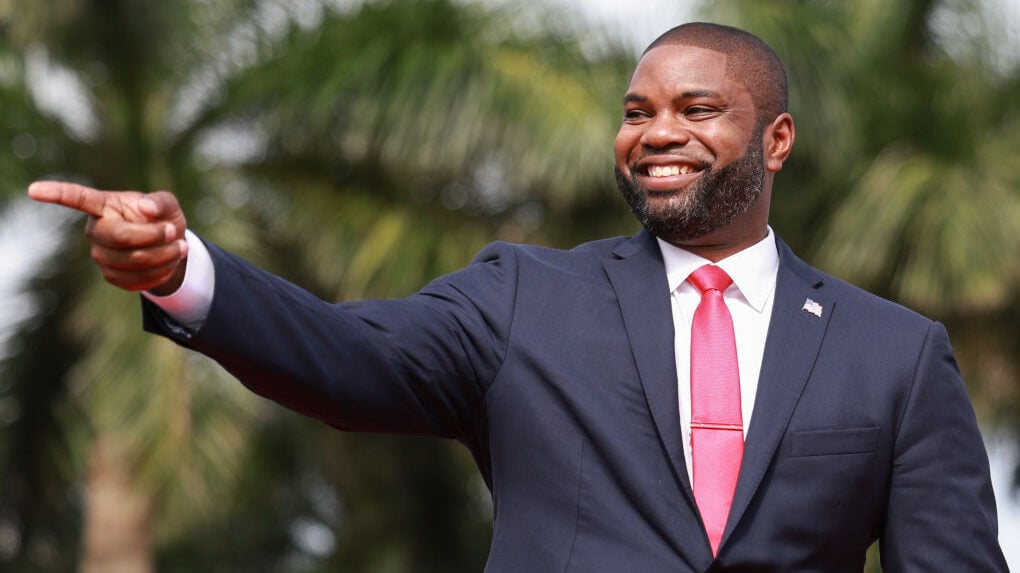
U.S. Congressman Byron Donalds is hoping to ride the Trump wave straight to the governor’s office in Florida. In a state where President Trump calls home and a Democrat has not won a gubernatorial election since 1994, Donalds may be poised to become the Sunshine State’s next governor. If elected, the Republican nominee would become the state’s first Black governor, and the first Black Republican governor in U.S. history.
Despite the historic nature of Byron Donalds’ gubernatorial campaign, he hasn’t leaned into it. When asked about the significance of potentially being elected Florida’s first Black governor, Donalds told CBS News, “I’m aware of it, but I don’t really focus on it.”
Donalds, a Brooklyn native known for his strong communication skills, emerged as a top national Republican after being unsuccessfully nominated for Speaker of the U.S. House of Representatives by members of the Republican Caucus. From there, Donalds began using his newfound national microphone to defend Trump during the 2024 presidential election. The 47-year-old, who took office at the beginning of the Biden administration, became a prominent Republican voice trying to convert Black voters, namely Black men, who traditionally vote Democratic, to support Trump’s re-election bid.
Donalds has backed President Trump’s anti-DEI agenda, dismissing the need for diversity and equity policies to close gaps in racial disparities as a “false premise.” He’s also been criticized by Black leaders over controversial statements about race in America, like saying that “the Black family was together” during the Jim Crow era.
John James, Republican gubernatorial nominee in Michigan

U.S. Congressman John James is facing an uphill battle for the governorship in Michigan, a battleground state where Trump’s unpopularity appears to be weighing down his historic candidacy. The Black Republican is trailing Democratic gubernatorial nominee and current Michigan Attorney General Jocelyn Benson in every public poll.
James has sought to frame Benson as business as usual and part of a failed governance by Democrats over the past nearly eight years under Democratic Gov. Gretchen Whitmer. However, Whitmer, who was elected twice as governor and is term limited, remains popular with a job approval rating above 50%.
“Jocelyn Benson promises a new direction, but she’s been a part of the leadership that got us lost in the first place,” James has said.
James also faces challenges uniting the Republican base of voters after a contentious primary election, so much so that James was booed at the Michigan GOP Convention.
As theGrio previously reported, James entered the race in April 2025 after two unsuccessful U.S. Senate campaigns. The Army veteran won Michigan’s 10th Congressional District in 2022 and was reelected in 2024. His gubernatorial campaign received Trump’s endorsement, which gave him a needed boost in the primary.
Shanay Watson-Whittaker, Reproductive Freedom for All Director of Michigan Campaigns, told theGrio, “John James’s own party isn’t even buying what he is selling, and we cannot afford to let someone like him in the governor’s mansion to continue cutting access to health care that Michiganders rely on.”


Responses